Health and Nutritional Information Today
|
|
|
1. Prevention. Diets, Diet plans, foods and dietary supplements that provide health management
 through disease and symptom prevention.
Health conditions
are preventable through nutritional information about those conditions and measures you can take to either heal or prevent. Prevention is always the best medicine.
I want to help you, "Feed a man a fish and you have feed him for a day, teach a man how to fish
and you have feed him for life". If you are overweight and/or obese most people just want to sell you a bigger chair,
I want to show you a healthier and better way. through disease and symptom prevention.
Health conditions
are preventable through nutritional information about those conditions and measures you can take to either heal or prevent. Prevention is always the best medicine.
I want to help you, "Feed a man a fish and you have feed him for a day, teach a man how to fish
and you have feed him for life". If you are overweight and/or obese most people just want to sell you a bigger chair,
I want to show you a healthier and better way.
 2. Performance. Whether you are body building, needing sports nutrition or exercising for good health we are all about finding nutritional products
that provides health enhancement through improved physical and mental condition.
2. Performance. Whether you are body building, needing sports nutrition or exercising for good health we are all about finding nutritional products
that provides health enhancement through improved physical and mental condition.
The focus is on daily health, accomplishment and success.
3. Wellness.
Wellness benefits are about feeling good and finding balance.
This is a holistic approach to health care that includes the body,
mind and spirit through meditation to finding balance in mind, body and spirit. The focus is on daily health needs, MODERATION (we have to long overconsumed)
and variety.
 4. Nurturing. Foods that can supply a sense of caring for the health and quality of life for yourself and others and the associated sense of satisfaction
for the caregiver. Marketing a product from this platform would include a focus on growth and development, aging and healing. Nurturing yourself and others and nurturing
the environment around you. Environmentally friendly products for the inside and well as the outside. From the things we eat to the things we wear, they
all have an impact on the world we live.
4. Nurturing. Foods that can supply a sense of caring for the health and quality of life for yourself and others and the associated sense of satisfaction
for the caregiver. Marketing a product from this platform would include a focus on growth and development, aging and healing. Nurturing yourself and others and nurturing
the environment around you. Environmentally friendly products for the inside and well as the outside. From the things we eat to the things we wear, they
all have an impact on the world we live.
 5. Cosmetics. Cosmetics, how we look and feel about ourselves, benefits women's health and men's health. Looking good and enhancing self-esteem through
improved physical condition and personal appearance are corner stones to good health.
No matter
how well you eat if you have low self esteem, are worried or upset then the body gets out of balance.
5. Cosmetics. Cosmetics, how we look and feel about ourselves, benefits women's health and men's health. Looking good and enhancing self-esteem through
improved physical condition and personal appearance are corner stones to good health.
No matter
how well you eat if you have low self esteem, are worried or upset then the body gets out of balance.
|
|
Chelation TherapyChelation and Chelation Therapy
- 1. What is EDTA chelation therapy?
- 2. Does EDTA chelation therapy have side effects?
- 3. How might EDTA chelation therapy work to clear blocked arteries?
- 4. Is there evidence that EDTA chelation therapy works for CAD?
- 5. How frequently is EDTA chelation therapy used?
EDTA Capsules from Wonder Laboratories
Introduction To EDTA (Ethylenediaminetetraacetic Acid)
There are several forms of EDTA on the market. EDTA disodium chelate is best. This form of EDTA is one of the best-absorbed forms
of EDTA. It is acid resistant and passes through the stomach (without being absorbed) into the small intestine where it is absorbed into the blood stream.
Our EDTA is not the Magnesium form used in agriculture.
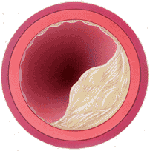
EDTA chelation therapy is a no surgical treatment for heart disease. Doctors use a synthetic solution,
called EDTA (ethylenediaminetetraacetic acid), to pull unsafe waste from your bloodstream. This cleaning process leaves you with an improved blood supply to your
legs, heart, and other organs. EDTA chelation therapy can help you avoid heart and artery disease.
EDTA improved blood flow, which can help people with arthritis, Parkinson's disease, and multiple sclerosis. Increasing blood flow helps rejuvenate the digits of the
hands and feet. Numbness in the legs have been reported to be reduced or disappear.
EDTA first was introduced and used as an intravenous solution. In recent years several other forms of delivery have been used with success i.e. liquids, powder,
suppositories, and capsules. All appear to be successful. Cost of EDTA is related directly to the delivery.
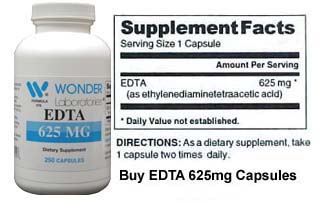 Capsules
and tablets work over a longer period of time
but are MUCH less expensive while on the other end of the spectrum is intravenous costing up to thousands of dollars for a complete treatment.
Capsules
and tablets work over a longer period of time
but are MUCH less expensive while on the other end of the spectrum is intravenous costing up to thousands of dollars for a complete treatment.
It is recommended that a less expensive alternative be used unless there is recent heavy metal poisoning causing immediate health risk. It is highly recommended
that tablets, capsules,
suppositories or powder be used if EDTA is being used as a maintenance supplement.
Buy EDTA
1. What is EDTA chelation therapy?
Chelation is a chemical process in which a substance is used to bind molecules, such as metals or minerals, and hold them tightly so that they can
be removed from a system, such as the body. In medicine, chelation has been scientifically proven to rid the body of excess or toxic metals. For example, a person
who has lead poisoning may be given chelation therapy in order to bind and remove excess lead from the body before it can cause damage.
In the case of EDTA, EDTA
chelation therapy, the substance that binds and removes metals and minerals is EDTA (ethylene diamine tetra-acetic acid), a
synthetic, or man-made, amino acid that is delivered intravenously (through the veins).
EDTA
was first used in the 1940s for the treatment of heavy metal
poisoning. EDTA
chelation removes heavy metals and minerals from the blood, such as lead, iron, copper, and calcium, and is approved by the U.S. Food and
Drug Administration (FDA) for use in treating lead poisoning and toxicity from other heavy metals. Although it is not approved by the FDA to treat CAD,
some physicians and alternative medicine practitioners have recommended
EDTA
chelation as a way to treat this disorder.
2. Does EDTA chelation therapy have side effects?
...
Continue reading about Chelation Therapy
|